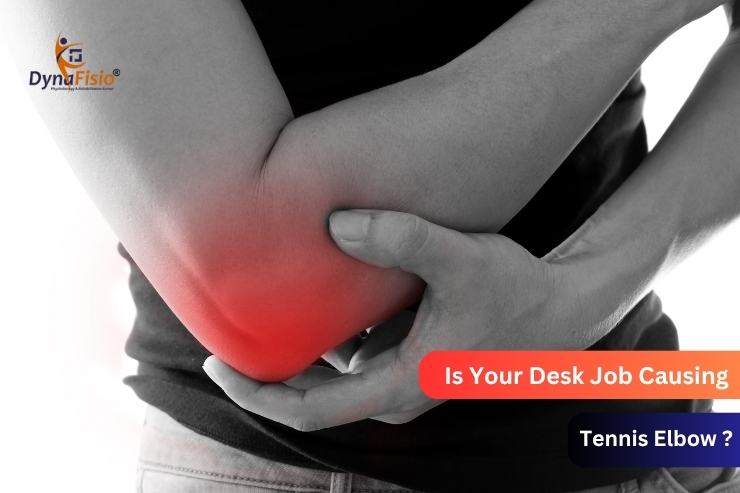
Think Tennis Elbow is only for athletes? Think again. Despite the sporty name, Tennis Elbow (Lateral Epicondylitis) is increasingly common among working professionals, especially those with desk jobs that involve repetitive hand and wrist movements.
At DynaFisio, we’ve treated dozens of IT professionals, writers, designers, accountants, and office executives who walked in with elbow pain they couldn’t explain until we traced it back to their desks. If you’ve been experiencing pain on the outside of your elbow while typing, using a mouse, or lifting your coffee mug, you might be suffering from Tennis Elbow caused by your work routine.
Tennis Elbow is an overuse injury that affects the tendons connecting your forearm muscles to the outer part of your elbow. Repetitive motion, not just in sports but also in typing, clicking, writing, or lifting, can cause microtears in these tendons, leading to inflammation, pain, and weakness.
You don’t need to swing a racket to get Tennis Elbow; just working 8+ hours a day on a laptop is enough.
Here’s how your daily desk habits may be setting you up for elbow pain:
Repetitive Mouse Use: Small, frequent movements while dragging, clicking, or scrolling strain the extensor muscles in the forearm.
Keyboard Overuse: Long hours of typing without wrist support can tighten and fatigue your forearm tendons.
Poor Ergonomics: A poorly placed desk, keyboard, or screen forces unnatural arm positions, putting additional stress on your elbow and wrist.
Heavy Lifting at Office/Home: Even lifting files, laptops, or your child repeatedly with a weak grip can contribute to the injury.
The result? Gradual, nagging pain that gets worse with time and doesn’t always go away with rest.
Not all arm pain is Tennis Elbow, but here are symptoms that shouldn’t be ignored:
Pain or tenderness on the outer part of the elbow
Weak grip (trouble opening jars or bottles)
Discomfort when lifting light objects like a cup or a phone
Pain that worsens with typing, writing, or using a mouse
Stiffness in the elbow or forearm, especially in the morning
If these symptoms persist for more than a few days or keep returning, it’s time to seek expert advice.
Ignoring Tennis Elbow can lead to chronic pain, limited arm movement, and reduced work efficiency. Many professionals adapt by avoiding movement, using the other hand, or taking painkillers, but these are temporary fixes.
The longer you wait, the more difficult it becomes to treat the inflammation. Eventually, the tendon damage may require months of rehab, and in rare cases, surgical intervention.
At DynaFisio – Elbow Pain Physiotherapy in Gurgaon, we’ve developed a work-specific treatment plan for Tennis Elbow caused by desk jobs.
Here’s how we help:
We assess your elbow, wrist, posture, and even your workstation habits to identify the root cause of the pain.
Using a combination of ultrasound therapy, TENS, cold compresses, and manual therapy, we help reduce inflammation quickly and effectively.
We guide you through forearm stretches, tendon-loading exercises, and wrist stability drills to rebuild strength without overloading the joint.
We advise on desk setup, typing posture, mouse usage, and hand positioning to ensure your recovery lasts.
Our recovery plan is designed for working professionals — short, effective exercises you can do during breaks, and simple modifications that don't interrupt your routine.
Even if you don’t have pain now, these tips can help keep your elbows healthy:
Use ergonomic keyboards and a mouse with wrist support
Take breaks every 30–45 minutes to stretch your hands and arms
Avoid lifting heavy bags with one hand repeatedly
Strengthen your grip and wrist with simple resistance exercises
Keep elbows supported and wrists relaxed while typing
Tennis Elbow isn’t just for tennis players; it’s becoming a modern desk-job epidemic. If you’re facing persistent elbow pain and you work long hours on a computer, you’re not alone, and you don’t have to suffer in silence.
At DynaFisio, under the expert care of Dr. Jyoti Arya, we offer personalized, non-invasive treatment that gets you back to work pain-free and stronger than before.